
What Is the Integration System? A Psychologist's Framework for Stress, Anxiety and Burnout
Apr 02, 2026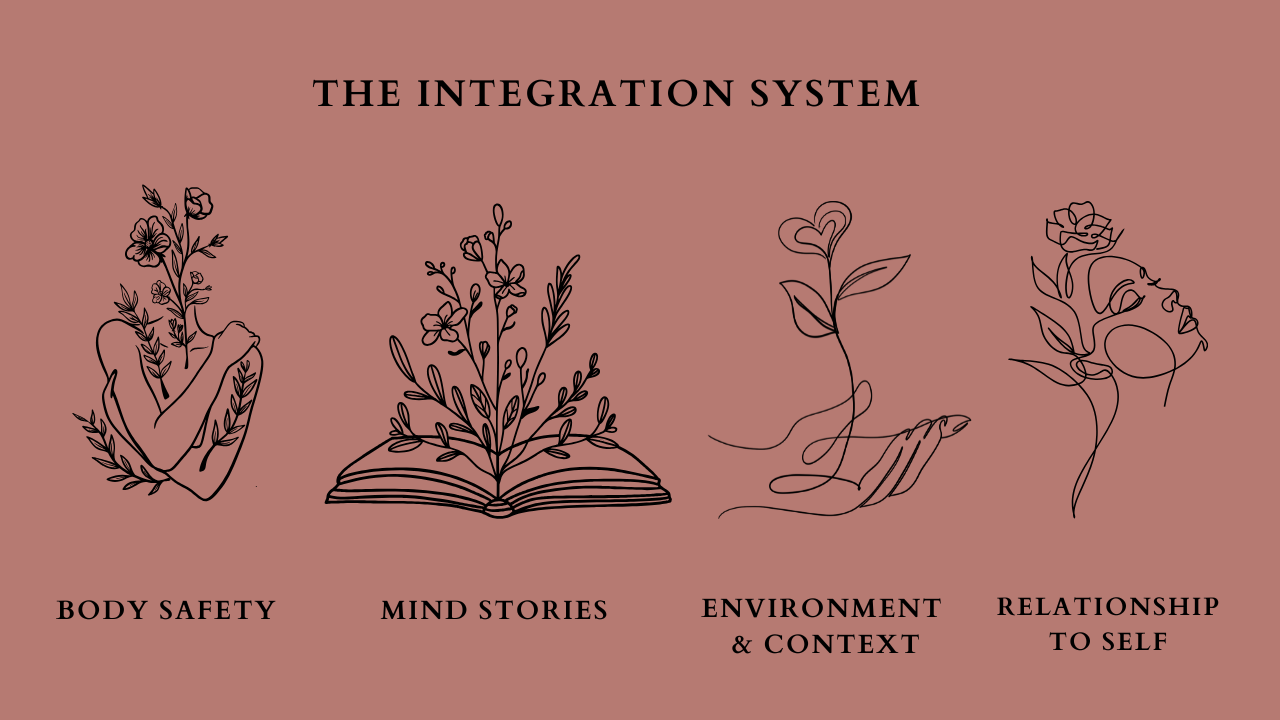
Written by Natasha Kiemel-Incorvaia, Registered Psychologist (PSY0001977411)
It is 9pm and your kids are finally asleep. You sit down and open your phone, not because you want to scroll, but because your brain is too wired to do anything else and too drained to do anything useful. And you are trying. You have tried the breathing app your friend told you about, going to bed early, even journaling... and they help but only briefly. Then you have a busy week at work and find yourself right back at the same place. This is the cyclic pattern the Integration System is designed to address.
If that cycle sounds familiar, you are not alone. In my clinical work with women, this is one of the most common patterns I see, women trying things that genuinely help for a while, but then life gets busy again and they stop. Not because of lack of effort or commitment but because the approach was only working with one piece of the puzzle.
The Integration System is the four-pillar educational framework I developed to help women make sense of their stress, anxiety and burnout-like exhaustion across the areas that tend to interact and reinforce each other [3,4]. Working across these areas is also how the framework supports emotional regulation, the capacity to respond to your emotions rather than being overtaken by them.
Most stress-related difficulties arise from several interacting factors at once, which is why addressing only one area at a time often provides relief but not lasting change.
This article offers general information and education only. It is not a substitute for personalised psychological or medical care. If you are experiencing significant distress, please speak with your GP or a registered psychologist.
Why is Treating One Symptom Often Not Enough?
Think about the last time you noticed the exhaustion really setting in, not just a tired afternoon, but that deeper, flatter kind of tired that sleep does not fix. Often there are several things converging at once: a high workload, a mind that will not stop running problem-solving loops, a daily routine with no real recovery built in, and a very harsh inner critic who adds a second layer of pressure on top of everything else.
Stress-related difficulties rarely arise from a single cause, and they rarely respond to a single intervention [3]. Population data shows that anxiety disorders are the most common mental health condition in Australia, affecting around 17% of the population [5], and the National Study of Mental Health and Wellbeing found they frequently occur alongside mood difficulties, physical health challenges, and significant life stressors at the same time [3]. These factors interact and reinforce each other, which is part of why a single-focus approach often helps for a while but tends to produce less lasting change than working across several areas together.
For many women, this is not a willpower problem. It is a recovery problem unfolding across the body, mind, daily context, and relationship with self.
Focusing only on one piece can be genuinely useful, but it may not be enough when:
- Workloads or caregiving demands remain high with little room for recovery.
- Prolonged stress has already affected sleep, concentration, or energy [3,4].
- Thought patterns such as self-criticism or perfectionism are actively maintaining the pressure [4,6,7].
- A difficult relationship with yourself makes it hard to rest, say no, or ask for support [4,6,8].
Working gently across several of these areas in a structured way over time may support more sustainable change for some women [3,4]. It does not guarantee specific outcomes for any individual, and it is not a substitute for clinical care where that is needed. But it can begin to address what is driving the exhaustion, rather than just managing how it shows up [3,4].
What Is the Integration System?
The Integration System is a four-pillar framework I developed to help women understand and work with their stress, anxiety and burnout-like experiences across the areas that tend to interact:
- Body safety
- Mind stories
- Environment and context
- Relationship to self
It is grounded in the understanding that wellbeing is shaped by the ongoing interaction of biological, psychological, and social factors, not any one cause in isolation [3,4,9]. Each pillar draws on established research: chronic stress and the nervous system, cognitive patterns and their role in maintaining distress, occupational and parenting demands and recovery, and self-compassion [3,4,6,7,9,10].
The framework has not been evaluated in randomised controlled trials and is not presented as a treatment. It is educational, designed to help you organise what is going on, notice patterns, and choose small experiments. One pillar will not hold on its own. All four working together is where the shift tends to happen.
Pillar 1: Body Safety, What It Means and Why It Matters
You know that feeling of sitting down at the end of a long day and realising your shoulders have been up near your ears for the past four hours? Or lying in bed genuinely wanting to sleep, and your body just will not cooperate, heart rate slightly elevated, mind still turning things over?
Or the other version: you sit down and instead of feeling wound up, you feel nothing at all. Flat. Disconnected. Like you are going through the motions but not quite there. You are not relaxed; you are just empty.
Both of those are your nervous system telling you something.
Body safety is about how your nervous system and stress-response systems move between activation and recovery, and how easily they can return towards a steadier state once pressure has passed. That steadier state is not the same as calm. For some women it means coming down from high alert. For others it means coming back online from a place of flat, checked-out exhaustion. Both directions matter.
Research on stress and allostatic load describes how the body accumulates wear and tear when stress responses are repeatedly activated without enough recovery time [4,9,11]. The body is doing exactly what it was built to do under threat. The difficulty is that it was built for short-term threats, not months of sustained pressure with no clear signal that it is safe to come down. Over time, this process can affect sleep, immune function, mood, concentration, and energy in some people [4,9,11].
If the tired but wired pattern is the most familiar part of this, this post on why your body feels always on even when you are exhausted explains what is happening in the nervous system and what tends to help.
Body safety shows up in questions like:
- How quickly do you notice when you are becoming tense, on edge, or shut down?
- How easy is it to come back from those states once the immediate pressure has passed?
- Do you have practices that support your body in both directions, settling when you are wound up, and re-energising when you are flat or checked out?
Body safety is also the starting point of the Integration System for a clinical reason: when the body is in sustained activation or deep shutdown, the capacity for the kind of reflective and cognitive work that the other pillars involve is genuinely reduced, and emotional regulation tends to be harder to access. You need a degree of physical steadiness before the thinking work can land.
Working with this pillar involves educational practices: gentle breathing, intentional movement, sensory grounding, structured wind-down routines, and practices that help bring you back online when you are flat or withdrawn, adjusted to your health needs and starting point. These practices may support body awareness and steadier states for some women, but they are skills-building rather than medical treatment and will not have the same effect for everyone [3,4,11].
If you would like to go deeper on what nervous system regulation means and how to work with it practically, this post on nervous system regulation for women covers the body safety pillar in more depth.
Revitalise sits most strongly in this pillar, offering structured, nervous-system-informed practices across both directions, framed as skills to try, not solutions.
If you are recognising your own pattern in this, the free Regulation Profile Quiz can help you understand how your body is already responding under stress, including which senses you naturally regulate through. It takes five minutes. Take the quiz here.
Pillar 2: Mind Stories, The Thoughts and Patterns That Keep You Stuck
You finally sit down. The house is quiet. And immediately, somewhere in the back of your mind, a voice starts up:
- "I should be using this time better."
- "I haven't done enough today."
- "If I rest now, it will all just pile up."
Many of the women I work with recognise those immediately. Mind stories are the patterns of thoughts, beliefs, and interpretations that show up under stress, often so automatic and familiar that they feel like facts rather than patterns.
Research on stress and burnout suggests that rigid perfectionism, persistent self-criticism, and chronic worry may contribute to maintaining distress and exhaustion, particularly when combined with high demands [4,6,7,12]. These patterns do not cause burnout or anxiety on their own. But they can make it significantly harder to slow down when you are already running on empty, drive overcommitment when you already have too much, and intensify feelings of failure when you inevitably cannot meet an impossible standard.
Working with this pillar involves noticing common thought themes, how you talk to yourself, learning to relate to your thoughts differently rather than fighting them, and gently experimenting with more flexible and compassionate alternatives. Two approaches used to work with these kinds of patterns are skills from cognitive behavioural therapy (CBT) and Acceptance and Commitment Therapy (ACT) [6,7]. Working with these thought patterns is also part of how you build emotional regulation, alongside the body-based work in the Body Safety pillar.
Soften and Surrender into Slow focuses primarily on this pillar, helping women work with resistance to rest and the thought patterns that keep the nervous system stuck in busyness, as skills-building rather than treatment.
Pillar 3: Environment and Context, How Your Daily Context Shapes Your Nervous System
Here is something I come back to a lot in my clinical work: the best mindset tools in the world have limited impact when the environment they are being used in has not changed. If you are carrying a full-time job, primary caregiving, household management, and the emotional labour of holding most of the relationships in your life, no amount of breathwork is going to change the structural load on your system.
Environment and context refer to the practical context you are actually living in: workload, caregiving responsibilities, financial pressures, the quality of your close relationships, home dynamics, digital use, commute, and the rhythms of your days and weeks.
Occupational health research, including Australian workplace data, consistently finds that high demands combined with low resources and limited recovery are linked with exhaustion, disengagement, and burnout-related experiences [1,2,13,14]. For many women, those demands extend well beyond paid work. Unpaid domestic and caring labour, emotional labour, and the constant management of other people's needs all add to the overall load on the system.
This pillar asks:
- How much genuine recovery time is actually available between intensive days or periods?
- How predictable or chaotic do daily routines feel?
- What is the quality of support available in your close relationships, and are those relationships currently a source of restoration or an additional drain?
- Are there any adjustments, large or small, that are available right now?
Working with this pillar sometimes means small, realistic adjustments: building brief recovery moments into existing routines, asking honestly not what boundaries you should have but which ones are actually available to you right now. And sometimes it means something bigger. A significant reduction in workload. A difficult conversation that has been deferred for months. A decision to stop doing something that has been steadily draining the system. This pillar does not prescribe what the change should be, but it does ask you to look clearly at whether the environment you are in is sustainable, and what, if anything, is available to shift. For some women, that clarity alone is the starting point. For others, having structure and support around them while they navigate it makes the difference [3,4,11].
Elements of this pillar are woven through all three courses. Invitation to Align and Elevate offers the most structured space for women to look carefully at how their specific environment and routines interact with their body and mind, and to work through what change might look like in their actual life, not a prescription.
Pillar 4: Relationship to Self, The Layer Most Approaches Leave Out
This is the pillar I find women most frequently dismiss first. In a culture that rewards productivity and capability, working on how you relate to yourself can feel like an indulgence, the kind of thing you will get to when everything else is sorted. The research suggests it is anything but.
Relationship to self is about how you speak to, care for, and stand with yourself over time, and the quieter ways you may be holding yourself back. It includes self-talk, self-compassion, values and identity, the standards you expect yourself to meet, and whether you follow through on commitments you make to yourself or quietly step away from them when things get hard.
One pattern worth naming directly is the tendency to keep figuring out the why as a way of avoiding the what. Understanding yourself matters. But there is a point at which continued analysis becomes a way of staying comfortable rather than a path forward. If you have recognised a pattern in yourself for a long time but have not yet moved on it, it is worth asking honestly whether more insight is actually what is needed, or whether something else is getting in the way. Perfectionism. Fear of getting it wrong. A belief that you are not quite ready yet. This is not a criticism. It is one of the most human and recognisable patterns there is, and it is also one of the most worth being honest about, because insight without action does not tend to reduce the exhaustion.
Research consistently finds that lower self-compassion and higher self-criticism are associated with higher levels of anxiety, depression, and stress, while greater self-compassion is linked with lower distress for many people [8,10]. This does not mean that simply being kinder to yourself will resolve complex difficulties. It means that harsh inner criticism and unrelenting expectations add a layer of suffering on top of existing stress, and that the way you relate to yourself can either support change or make it much harder to sustain over time [8,10].
This pillar asks:
- How do you speak to yourself when you are struggling, the same way you would speak to someone you care about, or considerably harsher?
- When you make a commitment to yourself, what usually happens next, do you back yourself, or do you find yourself procrastinating, minimising your needs, or moving the goalposts?
- How connected do you feel to your values and sense of self beyond productivity and achievement, and in what ways might old roles or expectations be keeping you in patterns that no longer fit?
- When you feel the pull to rest, ask for help, or change something, what shows up on the inside: encouragement, or a wave of fear, doubt, or "who do you think you are?" that talks you out of it?
Invitation to Align and Elevate is most closely linked with this pillar, offering a structured way to explore these internal patterns and practise responding to yourself differently, within an educational, group-based setting rather than a therapy context.
How the Integration System Supports Emotional Regulation
Much of what this framework is doing, across all four pillars, is supporting emotional regulation. Emotional regulation is not about controlling or quietening your emotions but about learning to notice them, make sense of them, and respond in ways that work for you, rather than being overtaken by them. Your emotions carry useful information, so the aim is to be able to work with them.
What is worth knowing is that emotional regulation does not happen in one place. It draws on more than one part of you at once, which is part of why a whole-system approach tends to support it more reliably than any single technique. The Body Safety pillar works from the body up, because when your nervous system is steadier, emotions usually feel more manageable in the first place. Research suggests people often regulate their emotional states through sensation, which is part of why body-based and sensory practices matter here [15]. The Mind Stories pillar works from the thoughts down, with the patterns and beliefs that shape how you interpret and respond to what you feel. Environment and Context shapes whether your daily life leaves any room to recover, and Relationship to Self shapes how you treat yourself while you are learning. Drawing on skills from approaches such as CBT, ACT and DBT, working across these areas over time may support a more flexible, workable relationship with your emotions for some women.
This is educational and skills-based, not therapy, diagnosis or treatment, and outcomes vary for each person.
How Do the Three Courses Sit Inside the Integration System?
If you are considering the courses, this table shows where each one primarily focuses within the four pillars:
| Course | Primary pillars |
|---|---|
| Revitalise | Body safety; environment and context. |
| Soften and Surrender into Slow | Mind stories; resistance to rest. |
| Invitation to Align and Elevate | All four pillars at an integrative level. |
This mapping shows where each course tends to focus. The courses are designed to help you build skills and understanding across these areas over time, so you have more options for how you respond to stress, anxiety, and exhaustion in daily life. They are not a guarantee or a quick fix, and what changes for you will depend on your situation and how you use the material. For many women, starting with one pillar is a realistic first step, and working across several pillars over time is where more sustained change often begins.
If You Have Taken the Regulation Profile Quiz: Where to Start in the Integration System
The Regulation Profile Quiz offers two kinds of information: your current nervous system state and your sensory regulation profile. Together they can help you decide where it might make sense to begin within the Integration System, and how to approach the practices inside whichever course you choose next. This quiz is for general information, reflection, and self‑understanding only; it does not provide a diagnosis or replace individual psychological or medical care. If you have concerns about your mental or physical health, please speak with your GP or a registered psychologist as a first step. This is a starting point for reflection, not a prescription. You know yourself better than any quiz does.
Your nervous system state result
If your result showed you are sitting closer to wound up, activated, or unable to switch off, Pillar 1 is a gentle starting point. The settling practices within body safety are where to begin. Revitalise focuses here.
If your result showed you are sitting closer to flat, checked out, or depleted, Pillar 1 is still the starting point, but the energising practices matter more than the settling ones. Revitalise covers both directions.
If your result showed your mind as the bigger barrier, resistance to rest, self‑critical loops, difficulty switching off mentally even when your body is tired, Pillar 2 is worth prioritising alongside Pillar 1. Soften and Surrender into Slow focuses here.
If your result showed a mix across several areas, or you recognised yourself in all four pillars, Invitation to Align and Elevate works across the whole framework.
If you have completed the quiz and are looking for a practical next step, Revitalise is usually the most natural place to begin. It focuses on body safety and nervous system support and can sit alongside individual psychological care where that is appropriate.
There is no right or wrong sequence; use this as a guide and choose what fits your life right now. If your quiz result feels very different to how you experience yourself, or if it raises concerns about your wellbeing, consider it an invitation to bring these observations to a GP or registered psychologist rather than something to interpret on your own.
Your sensory profile result
The quiz also gives you a sensory regulation profile, an indication of which senses you may naturally reach for when you are under stress. This draws on research suggesting that people tend to regulate their emotional states through sensation, and that those preferences vary between individuals across movement, sound, touch, scent, and sight [15]. Within both Revitalise and Invitation to Align and Elevate, you will find practices across all five sensory channels. Your profile is a useful starting point for deciding which ones to experiment with first. It is not a rule about which ones will work for you, and you may find that your actual responses sometimes surprise you.
If your profile showed a preference for movement, body‑based and grounding practices that involve physical sensation are a reasonable place to start. If it showed sound or music, practices that use auditory cues for wind‑down or activation may feel more natural early on. If it showed touch or scent, practices involving physical comfort, warmth, or adjusting your environment are worth trying first. If it showed sight, visual environment changes like adjusting lighting, reducing screen input in the evening, or orienting practices that use your visual field are a good starting point.
Sensory preferences shift depending on nervous system state, context, and what is actually available to you on a given day. A practice that does not feel natural at first may become more useful over time. One that feels immediately comfortable may not always be the one that shifts your system most effectively. Use the profile as a starting point, not a fixed prescription.
The aim is to give you somewhere to begin that is grounded in how your body already responds, rather than working through a generic list and hoping something sticks. If you are currently receiving psychological or medical care, you can share your quiz results with your treating practitioner so they can be considered in the context of your broader treatment plan.
When to Consider Individual Support
The Integration System is an educational framework, not a clinical intervention, and it works best when stress, anxiety or burnout-like exhaustion are part of everyday life rather than a crisis. There are times when individual assessment and support with a registered psychologist or GP are the more appropriate starting point.
It may be worth speaking with a professional if you notice:
- Persistent low mood, loss of interest in things you usually care about, or a sense of hopelessness that does not lift.
- Anxiety or worry that is hard to control most days and is affecting your ability to work, parent, or manage daily life.
- Significant changes in sleep, appetite, weight, or energy that are not explained by a change in circumstances.
- Physical symptoms such as chest pain, breathlessness, or persistent pain alongside the exhaustion.
- Use of alcohol or other substances to cope with distress.
- Thoughts of not wanting to be here, or of harming yourself.
If any of the above applies to you, please reach out to one of the services below or speak with your GP as a first step. A GP can also rule out medical causes of exhaustion, including thyroid issues, anaemia, and sleep disorders, which are worth excluding before attributing everything to stress.
What Is Your Next Step?
If you are reading this and recognising the pattern, trying one thing at a time, getting some relief, then ending up back at the same place, the free Regulation Profile Quiz is a gentle starting point. It is not a diagnostic tool. It helps you notice how your body may already be trying to support you when you feel overwhelmed, and offers some language and ideas you can take into whatever comes next.
Take the free Regulation Profile Quiz
This short psychoeducational quiz focuses on the sensory strategies your body may naturally reach for under strain, for example whether you tend to regulate more through movement, touch, sound, visuals, scent, or a combination of these, and gives you a simple profile with a few suggestions to experiment with.
Understanding how your system responds can be useful. It can guide what you try and help you make sense of patterns you may have been blaming yourself for.
This quiz is for reflection and self-understanding only; it does not provide a diagnosis and does not replace individual psychological assessment or treatment.
If you would like to read more about how the Regulation Profile Quiz works before taking it, you can find the full overview here.
Start where you are. You do not need to work on everything at once; you just need a clearer place to begin.
If the whole-system approach resonates and you are wondering about next steps:
- Use the four pillars as a lens to reflect on your own life, even without taking a course. Notice which pillar feels most neglected right now.
- Revitalise or Soften and Surrender into Slow if you want self-paced education and practice focused on one or two pillars.
- Join the Invitation to Align and Elevate waitlist if you are ready for a more guided, structured experience working across all four pillars.
All three courses are psychoeducation and skills-based programs. They are not therapy and are not a substitute for individualised psychological assessment or treatment. They are designed for women who want evidence-informed tools to support their wellbeing in daily life. If you are currently receiving clinical support, these courses can sit alongside that. Outcomes vary for each person. Available worldwide, including Australia, the UK, Ireland, New Zealand, Singapore, Hong Kong, Dubai and Switzerland, excluding the United States and Canada.
The aim is not to fix everything at once. It is to start making sense of what is actually driving the exhaustion, so that over time your choices feel a little more grounded and a little less like you are just pushing harder.
If you need urgent support
If you are in crisis, feeling unsafe, or worried about harming yourself, please contact:
In Australia: Emergency services: 000 | Lifeline: 13 11 14 | Beyond Blue: 1300 22 4636 | 1800RESPECT: 1800 737 732
If you are outside Australia, please contact your local emergency services or a crisis line in your country.

Written by Natasha Kiemel-Incorvaia, Registered Psychologist (AHPRA: PSY0001977411). Natasha is the founder of Gracefully Redefine You (natashacourses.com) and Graciously You Psychological Services. She works with women navigating stress, anxiety, burnout and nervous system dysregulation through self-paced psychoeducation courses and individual telehealth appointments.
References
[1] Ghasemi F, Beversdorf DQ, Herman KC. Stress and stress responses: A narrative literature review from physiological mechanisms to intervention approaches. Australasian Psychiatry. 2024.
[2] Corporate Calm. Australian Workplace Stress Statistics: 2026 Update.
[3] Australian Bureau of Statistics. National Study of Mental Health and Wellbeing, 2020-2022. Canberra: ABS; 2024.
[4] Policy implications of the 2020-22 Australian study of mental health and wellbeing. Australian & New Zealand Journal of Psychiatry. 2024.
[5] Life in Mind. National Study of Mental Health and Wellbeing: summary of key findings; 2023.
[6] Shafran R, Cooper Z, Fairburn CG. Clinical perfectionism: A cognitive-behavioural analysis. Behaviour Research and Therapy. 2002.
[7] Limburg K, Watson HJ, Hagger MS, Egan SJ. The relationship between perfectionism and psychopathology: A meta-analysis. Journal of Clinical Psychology. 2017.
[8] Neff KD. Self-compassion: An alternative conceptualization of a healthy attitude toward oneself. Self and Identity. 2003.
[9] Engel GL. The need for a new medical model: A challenge for biomedicine. Science. 1977.
[10] MacBeth A, Gumley A. Exploring compassion: A meta-analysis of the association between self-compassion and psychopathology. Clinical Psychology Review. 2012.
[11] McEwen BS. Physiology and neurobiology of stress and adaptation: Central role of the brain. Physiological Reviews. 2007.
[12] Demerouti E, Bakker AB, Nachreiner F, Schaufeli WB. The job demands-resources model of burnout. Journal of Applied Psychology. 2001.
[13] RACGP / AJGP. Burnout and wellbeing in the Australian general practice: risk factors and correlates.
[14] RACGP. Workplace stress presentations on the rise: poll; 2026.
[15] Dore, B. P., Boccagno, C., Burr, D., Hubbard, A., Long, K., Chen, O., Gruber, J., & Ochsner, K. N. (2023). Sensory emotion regulation: The role of sensation in emotional processing and regulation. Trends in Cognitive Sciences, 27(2), 110-123. https://doi.org/10.1016/j.tics.2022.12.004
